2.1.1.3 Additional parameters
The program BINGO is adapted for processing corrected image coordinates, which are related to the principal point of symmetry PPS. Known distortions and, if necessary, the refraction should be eliminated in the image coordinates before adjustment. Nevertheless, even after consideration of all known corrections, the central perspective inherent in the collinearity equation will not be reproduced quite rigorously. Remaining image deformations and atmospheric influences can be eliminated in the adjustment by considering additional parameters. The function of Mueller, Bauer and Jacobsen, consisting of 24 parameters, was selected here and modified and extended considerably for perfect results.
In addition, six parameters according to D. C. Brown have been inserted by request of several customers. The lens decentring parameters P1 and P2 are reasonable. Using the radial symmetric parameters K1 to K4 is not recommended, as they are strongly correlated with the focal width.
The parameters are chosen under program control. The user may start by giving all parameters, and then the program will iteratively trace those which are redundant. These parameters will not be included in the next iteration. After this program-controlled selection is finished, the user must adopt only those parameters for a possible new calculation which have been accepted as essential by the program, as otherwise the selection will start anew. This automatic process can be switched off by the user.
The additional parameters shall be included in the adjustment only when
- all gross errors have been eliminated in the data block, so that a considerable change of s0 (a posteriori standard deviation of unit weight) or the data-block unknown is no longer to be expected and
- good approximate values in the data file ITERA are available for all image and point unknowns, as the estimation of these parameters is highly sensitive against too rough approximations. When choosing the appropriate input option, care must be taken to ensure that the program really reads in these initial values from the data file ITERA.
If these conditions are neglected, the automatic selection process could, especially during the first iteration, eliminate parameters which are important for the adjustment. For the first start with additional parameters, s0 a priori should be selected 10-20% less for the image measurements than the last a posteriori s0 for this series of observation. Then the a priori s0 can be adapted to the a posteriori s0 by means of the variance-component estimation (q.v.) (see also Section 2.3.3).
During iteration in a selection process the redundant parameters are flagged for deletion and eliminated in the next iteration. This automatic selection is made according to the following criteria:
1) Correlation test q = 0.80
Principle :If two additional parameters correlate with each other by a coefficient larger than 0.80 these parameters are not independent. Therefore one can be omitted.
Procedure :The largest correlation coefficient is chosen from those > 0.80. That additional parameter (of the two), which has the larger total correlation is then flagged for deletion. This test is only carried out for those parameters which do not yet have a deletion flag.
2) Significance test α = 0.3
Principle :If the value of an additional parameter is below a given noise level, this parameter should be omitted. The same applies if it is ill-conditioned because of the given block configuration. Practical investigations have shown that the value should be set quite low. α = 0.3 corresponds to a parameter value which is equal to its own standard deviation.
Procedure :The quotient of the parameter value and its standard deviation is computed as test value. A parameter with a test value < 1.2 is flagged, unless it is correlated with another additional parameter with a correlation coefficient > 0.3, which already has a deletion flag. In this case no flag should be applied, as a larger parameter value can be expected during the next iteration.
3) Total correlation
Principle :The total correlation indicates to what extent a parameter can be replaced by the other parameters and therefore is redundant.

B :Coefficients of total correlation (diagonal matrix) 
I :Identity matrix
No value bii shall exceed 0.90.
Procedure :If no parameter has as yet been flagged for deletion by criteria 1 and 2, the system checks whether there are parameters with a total correlation > 0.90 . If so, the parameter with the largest total correlation will be flagged.
The selection process is finished when no parameter is flagged during iteration. The camera constant and the principal point will be included in these three tests. They are never flagged for deletion.
This selection process has been developed and optimized for aerial images with the format
230mm x 230mm. Smaller image formats are automatically adjusted. However the selection process for images with smaller image formats is not always ideal – especially for cameras with stronger distortions - therefore manual controls are recommended.
The value of an additional parameter represents the maximum influence on the image coordinates. The effects on the image geometry are shown in Appendix A. For a practical application the program ADPLO (BINGO tools) calculates the influence of the parameter values on the image geometry and shows it graphically. Program BgExport can export the influences on the image geometry numerically as a grid.
Additional parameters should only be used if their inclusion can be justified by the physical conditions prevailing at the time of data acquisition. If no physical basis can be established for an additional parameter, there is a risk that an undetected model error will be absorbed by that parameter, even though the parameter does not correctly represent the underlying effect.
For partial blocks the use of a separate group of parameters is possible if a separate camera name is defined. This should only be done, however, if justified by special circumstances as, for example, change of cassette during a photo flight or flights of partial blocks on different days. Otherwise such measure would deteriorate the stability of the block.
The new digital aerial cameras DigiCam, DMC, UltraCamD, UltraCamX, and others create each of their images from several part-images. For meaningful calibration it is necessary to be able to position and scale the image of each CCD sensor individually. The boundaries of the individual CCD elements are contained in the software. Based on the image coordinates the program can then automatically recognise the affiliation of a measured pixel to a particular CCD element and determine the correction parameters.
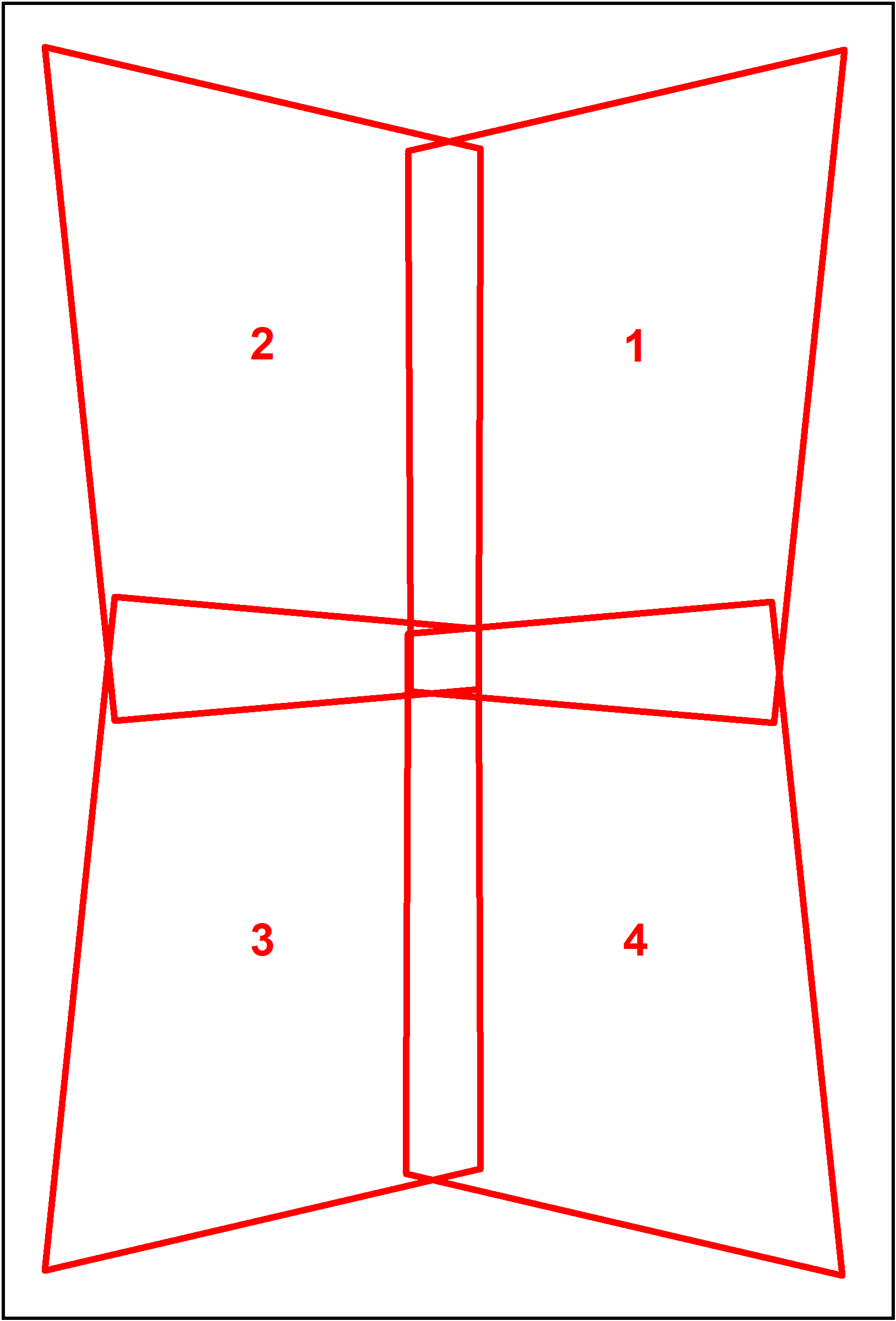
Fig. 2.1.1-5 Fragmental images of a DMC
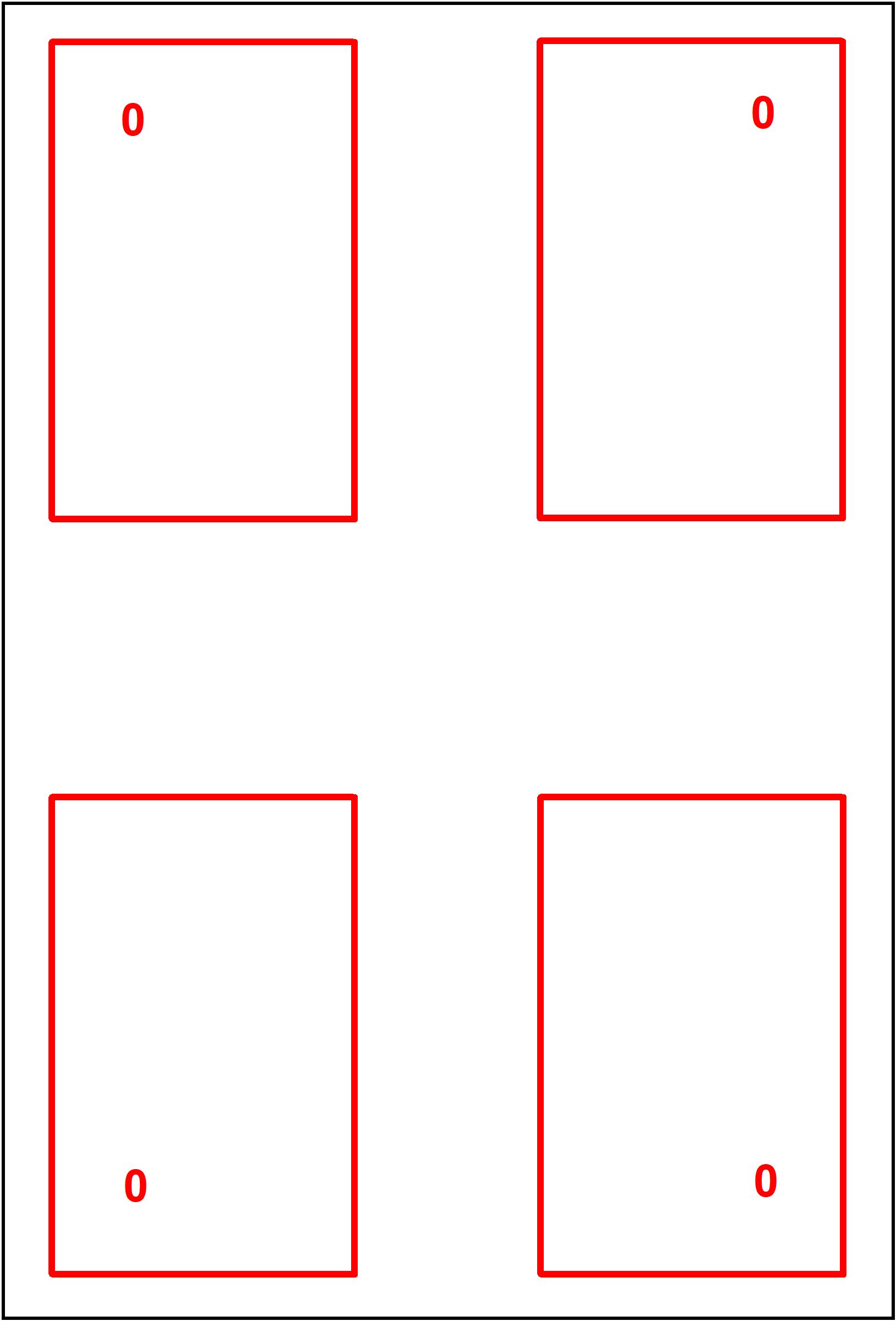
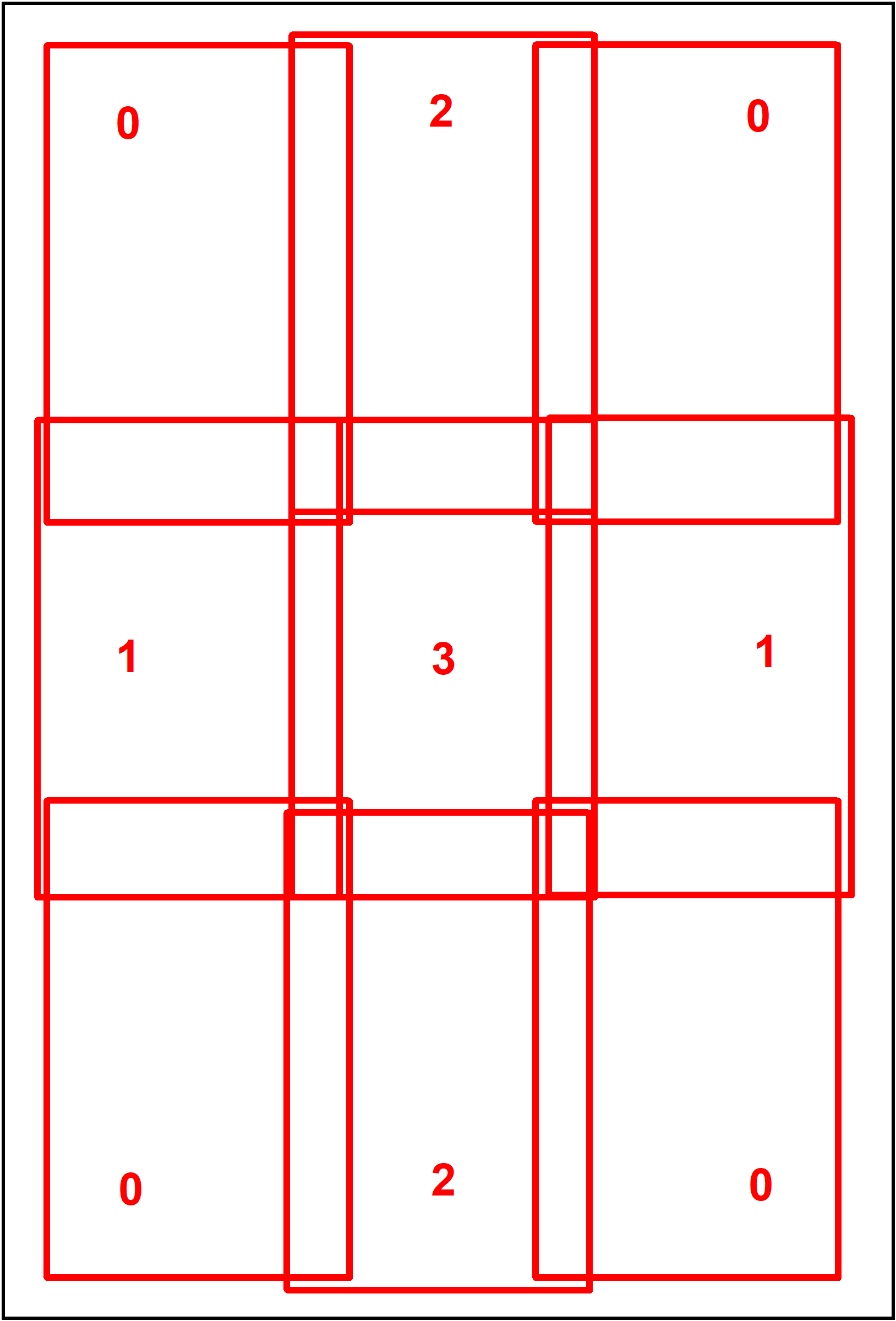
Fig. 2.1.1-6 Master Cone and fragmental images of an UltraCamD
The user has the possibility to switch off the automatic selection process for additional parameters, because often also not significant parameters are to be carried along within these applications.