2.3.3 Variance-component estimation
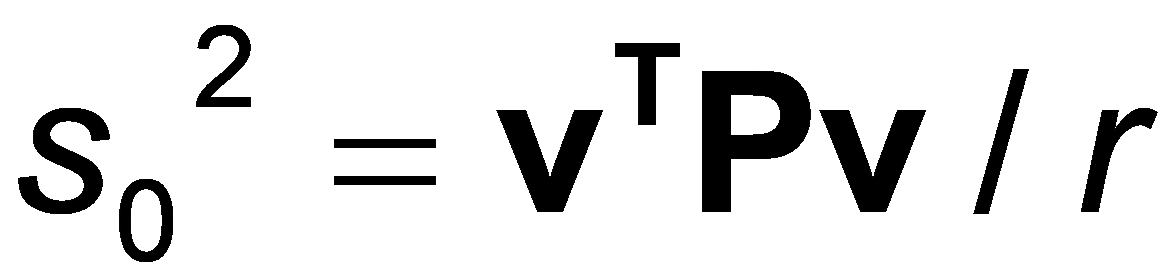
In addition to the magnitudes of the measured values, their standard deviations also influence the adjustment results. Also, reliable recognition of observation errors is only possible if the  of the residuals have been calculated correctly. These in return depend on the standard deviations of the measured values. If there are several groups of different observations, a global s0
r = n - u
of the adjustment is no longer sufficient for verification of the weight functions. A rigorous computation of s0 values for each observation group is time consuming. A good approximation, however, is obtained from
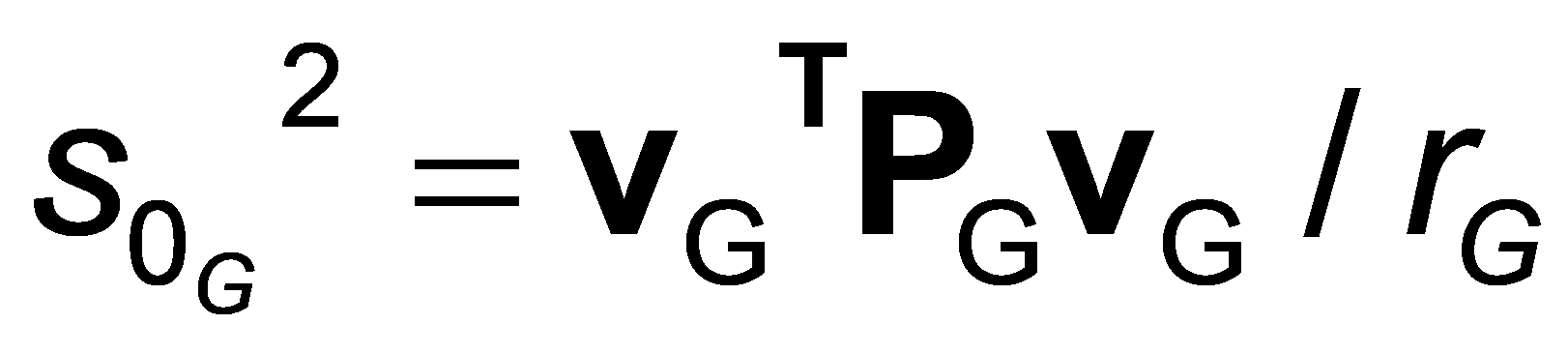

As independence of all observations is assumed here, the rG can be computed from (2.3.1/3) and (2.2/6):

Here only the diagonal is required from the matrix product  . Therefore those elements of
  must be known which differ from zero also in the normal equation matrix N. Thus the complete inversion of the normal equation matrix can be avoided, a task which is impossible for large data blocks.
The a posteriori standard deviation  calculated according to (2.3.3/2) is compared to the a priori function
  for each group. If there is sufficient redundancy in this group the a priori
  is to be changed by the user until convergence has been achieved. Then observation errors can generally be traced without difficulty.
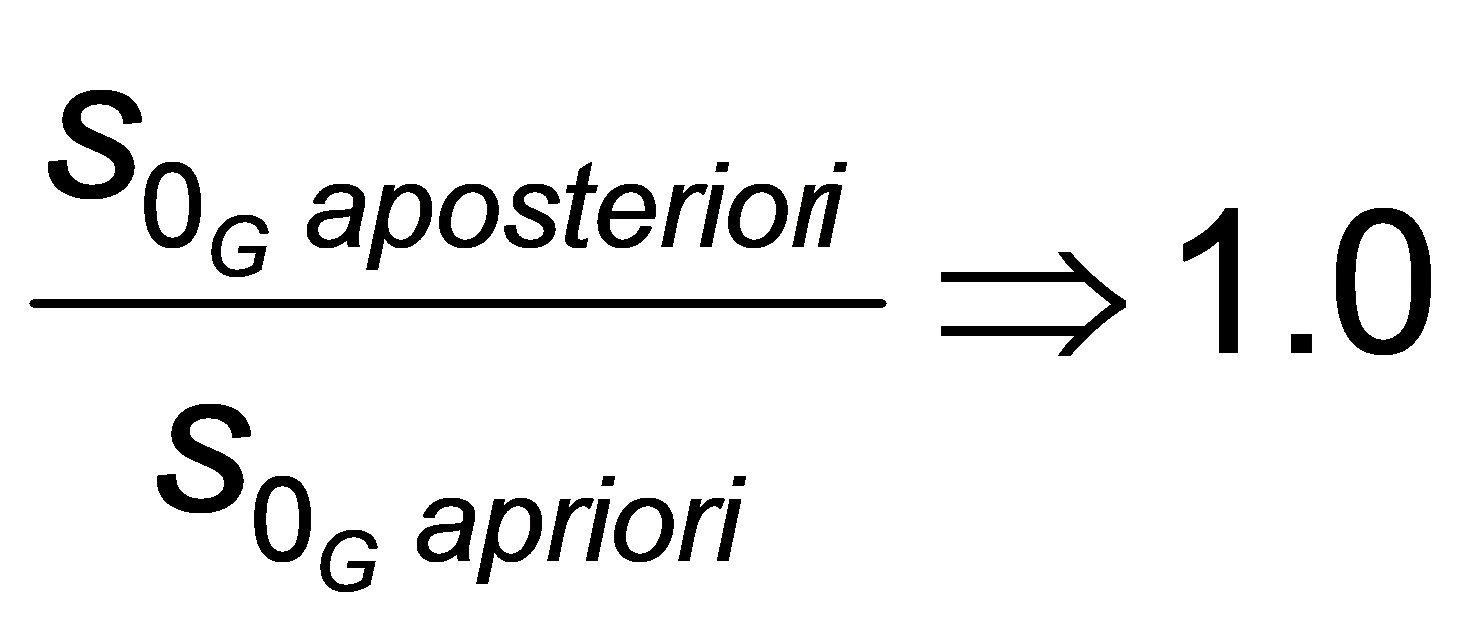
Although this is an approximate method, the resulting estimation of convergence (quotient = 1.0) is unbiased.