2.2 Stochastic model
The functional model according to adjustment of observation equations is given by l+v=Ax (equation 2.1/2). A standard deviation which describes the stochastic behaviour is attached to each observation l. These standard deviations form the diagonal elements of the matrix Qll. Then the weight matrix Pll is calculated by
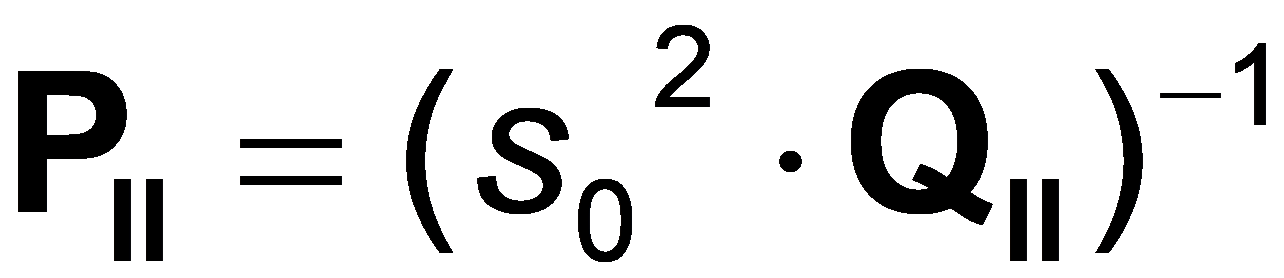
Only the diagonal elements are set with non-zero elements in the matrix P, because the observations are assumed to be stochastically independent.
While the values of the unknown parameters x in the adjustment are estimated according to equation (2.1/3), equation (2.2/2) indicates their stochastic behaviour.

 in equation (2.2/1) is the standard deviation of unit weight before the adjustment (a priori). in equation (2.2/2), however, is the empirical standard deviation of unit weight after adjustment (a posteriori) and is calculated from

where
r :redundancy
n :number of observations
u :number of unknowns
The weight coefficient matrix of the adjusted observations  is given by

The weight coefficient matrix Qvv of the residuals is then

The diagonal elements of this matrix Qvv are important for reliability, the search for small "gross" errors (blunders) according to the method of Baarda (data snooping), and for variance-component estimation.
The program BINGO provides a very flexible stochastic model:
- For image measurement, three special groups of points with different weights can be formed, so that up to four groups can be achieved.
- Alternatively, variable weight approaches can be applied for the image measurements depending on the image radius of the camera used.
- A common weight is applied for all stereo metric camera conditions which, however, permits different weight functions for the six equations resulting from each stereo metric image pair.
- For all remaining observation equations, a different weight for each equation may be given. This possibility should, however, only be used if justified by the circumstances of the measurements.