ECCA Eccentricity data of a camera
Columns | format | contents/explanation | |
|---|---|---|---|
1-4 | A4 | ECCA | |
5-20 | A16 | Camera name | |
21-30 | F10.0 | ex' | eccentricity vector e' |
51-60 | F10.0 | dφ | calibration angles dφ, dω, dκ |
The eccentricity vector e' defines the intersection of the rotation axes of a camera system in the image space. Thus, the projection centre is the origin. Nevertheless, the values of the vector components have to be entered in the same units as used for the object space.
Since the inner image angle τ' is hardly ever identical to the exterior image angle τ the components of vector e' in relation to the film plane or CCD array plane cannot be measured directly. A derivation of these quantities by direct measurement is only possible by reference to the front (object side) principal plane of the objective.
A change of the camera constant by dc' causes for terrestrial photos a change of ey' (for aerial photos a change of ez' ) by vdc', where v is a function of τ and τ' .
The calibration angles dφ, dω, dκ are defined as constant values as well in the camera. They indicate how far the orientations - measured with an IMU or a photo theodolite – have to be rotated until they correspond to the affiliated photo orientations. They are remaining residuals of a calibration and can be determined exactly in most cases only by simultaneous adjustment.
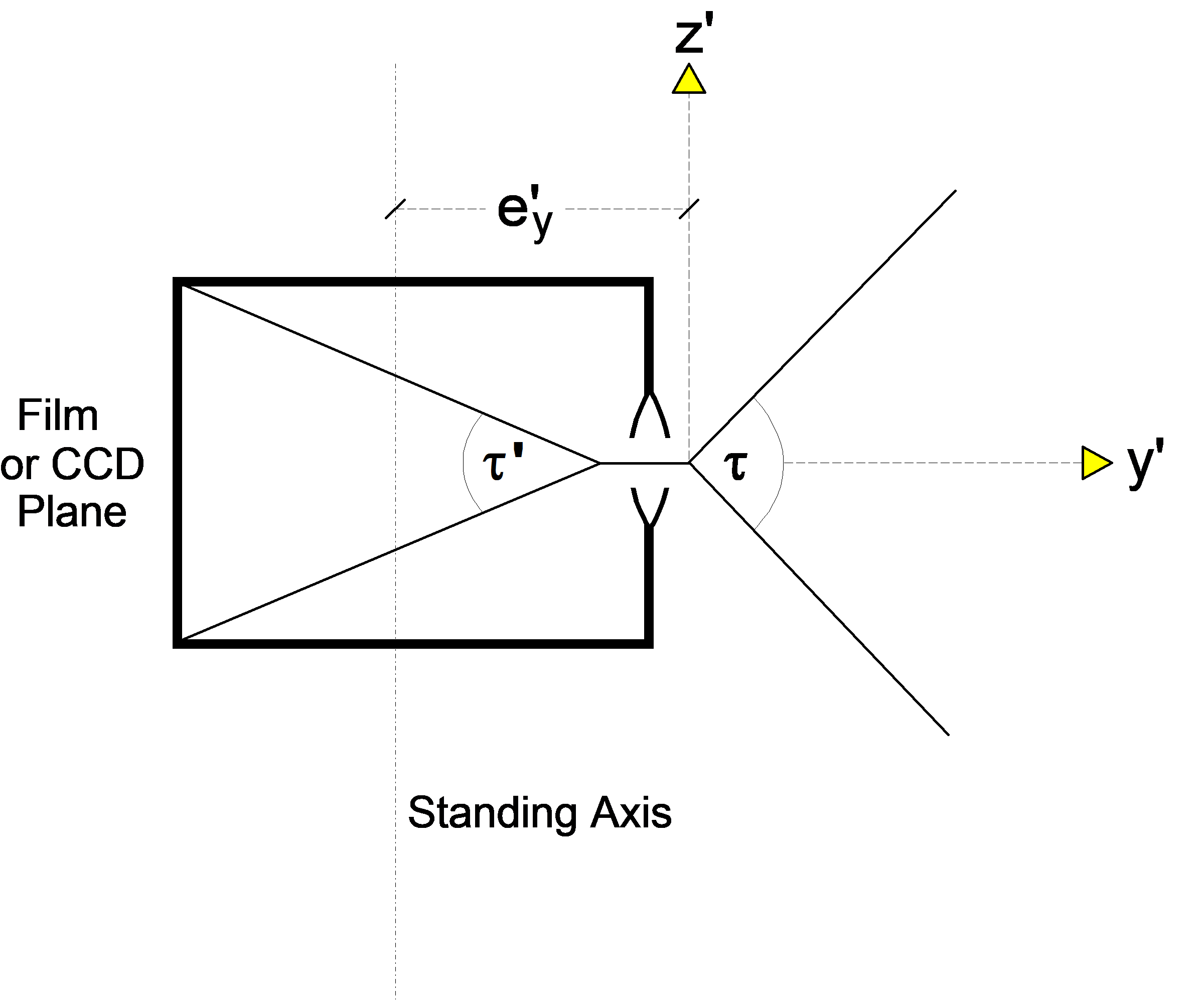
Fig. 5.6-1 Eccentricity of a camera
dφ, dω and dκ are defined differently for terrestrial photos and for aerial photos. For this reason, only measured photo angles for photos with a unique angle system are to be used within an adjustment for one camera – i.e. all photos with ORIA or all photos with ORIT.
The eccentricity vector e' and/or the calibration angles are automatically introduced to the adjustment as unknowns if they are included in an observation equation.
By means of the ECCA statement, the approximate values for the unknowns as well as the measurement for e' the calibration angles dφ, dω, dκ are read in. The ECCA statement gives approximations to the unknowns and measured values for e'. Whether a value is handled as a measured quantity or as an approximation depends on the preceding ECES statement. All values which have obtained a positive standard deviation from the preceding ECES statement are regarded as measured quantities. The corresponding unknowns are carried as observed unknowns. Here all three values of e' must be considered separately.
It is generally recommended to introduce e' and dφ, dω, dκ as measured quantities, even if the values are only roughly known. This may then be manifested by a large standard deviation (ECES statement).
A simultaneous calibration is recommended for accurate determination of vector e' and dφ, dω, dκ.