2.3.1 Inner reliability
The question of whether data errors are detectable and to what extent undetected data errors can falsify results of the adjustment leads to the concepts of inner and outer reliability. The relation between observations and residuals is expressed by

where  , which means the difference between the observations and their values computed from approximations. It is assumed that the observation li includes an error εi . Such an observation error effects on all residuals. The change in the corresponding residual vi is computed from

Therefore, for this problem, only the diagonal element is necessary from the product . This matrix product is also called the geometry matrix. The diagonal elements can assume values between zero and one and are called as redundancy components or redundancy numbers.
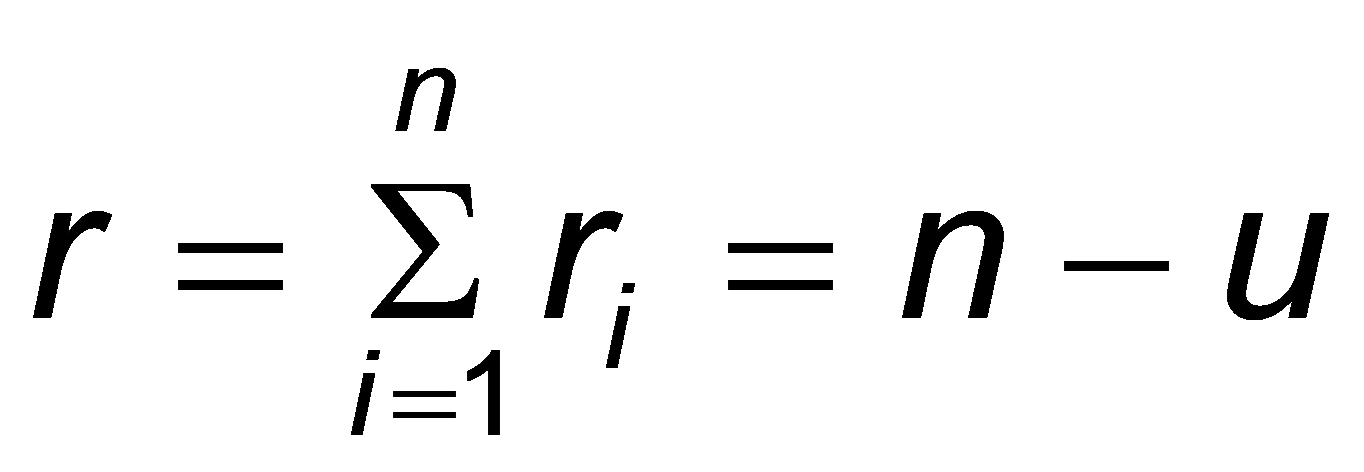
where
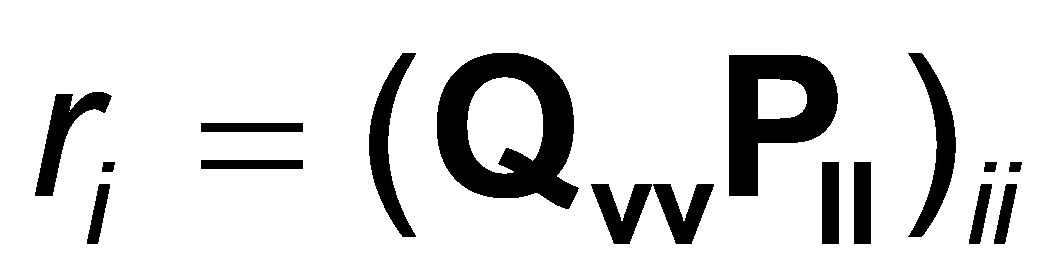
In BINGO this sum is used for a test computation. Thus equation (2.3.1/2) can also be written as

If the redundancy component of an observation is high (0.8 to 1.0) this observation is strongly controlled by other observations of the network but contributes very little to the determination of the unknown parameters of the block. Therefore, such observations could be dispensed with in a network optimisation. If the redundancy component of an observation is low (0.0 to 0.25) this observation is only poorly controlled by the other observations of the network. Such a value must therefore be measured very carefully as measurement errors are difficult to detect and strongly influence the unknowns of the block.
The inner reliability ri is computed for all observations if the option for data snooping is activated.
The outer reliability, which indicates the possible degree of falsification of results by undetected data errors, is not computed because of the large computation effort it needs.