4.1 Formats and references
Input of image coordinates is normally effected by the IMAGE COORDINATE file. Photo coordinates centred to the symmetry point are required (PPS principal point of symmetry). If this point is not known – like very often in digital images – the recommended reference is the image centre. It is highly recommended to choose mm as the unit for the image measurements. In case of the unit of measure being [micron] a corresponding parameter has to be set in the graphical user interface. The file has to be arranged photo by photo and must have the following data for each photo:
The first line contains photo and camera name. If the camera name is missing, the camera name of the preceding photo is used. The value for the camera name of the first photo is 1 if nothing else is indicated. Optionally, two dummy coordinate values between photo and camera name may be given. The end of the data of a photo is indicated by a minus sign in front of the last point name (for example -99). Then the next photo follows.
A photo name may appear more than once in a data set; such image data are then added to the previous set. A point name may also appear more than once in a photo data-set. An averaging will only be done automatically.
The input of the photo measures is effected with free format. However, it is highly recommended to have at least one blank at the beginning of each line, in order to avoid any problems later with a ″S″ from SKIP in column one. End of data is indicated by the END OF file or by an END statement.
First line : | photo name | camera name |
| P1 C1 |
next photo | photo name | camera name |
| P2 |
Photo data structure in principle. |
| Example with two photos. | ||
The following structure is valid (the square brackets [ ] indicate an optional input):
photo_name [ x' y' ] [ camera_name ]
The consecutive photo measurements are defined by the point name and the two coordinate values.
point_name x' y' [comment]
In addition to the image coordinates of object points, this file might also contain the image coordinates of fiducial marks or reseau points. These points should be named 1 to n, where n is the number of the fiducial marks. The points then can easily be eliminated by BINGO by definition of a range of point names which is valid for adjustment points in the object space.
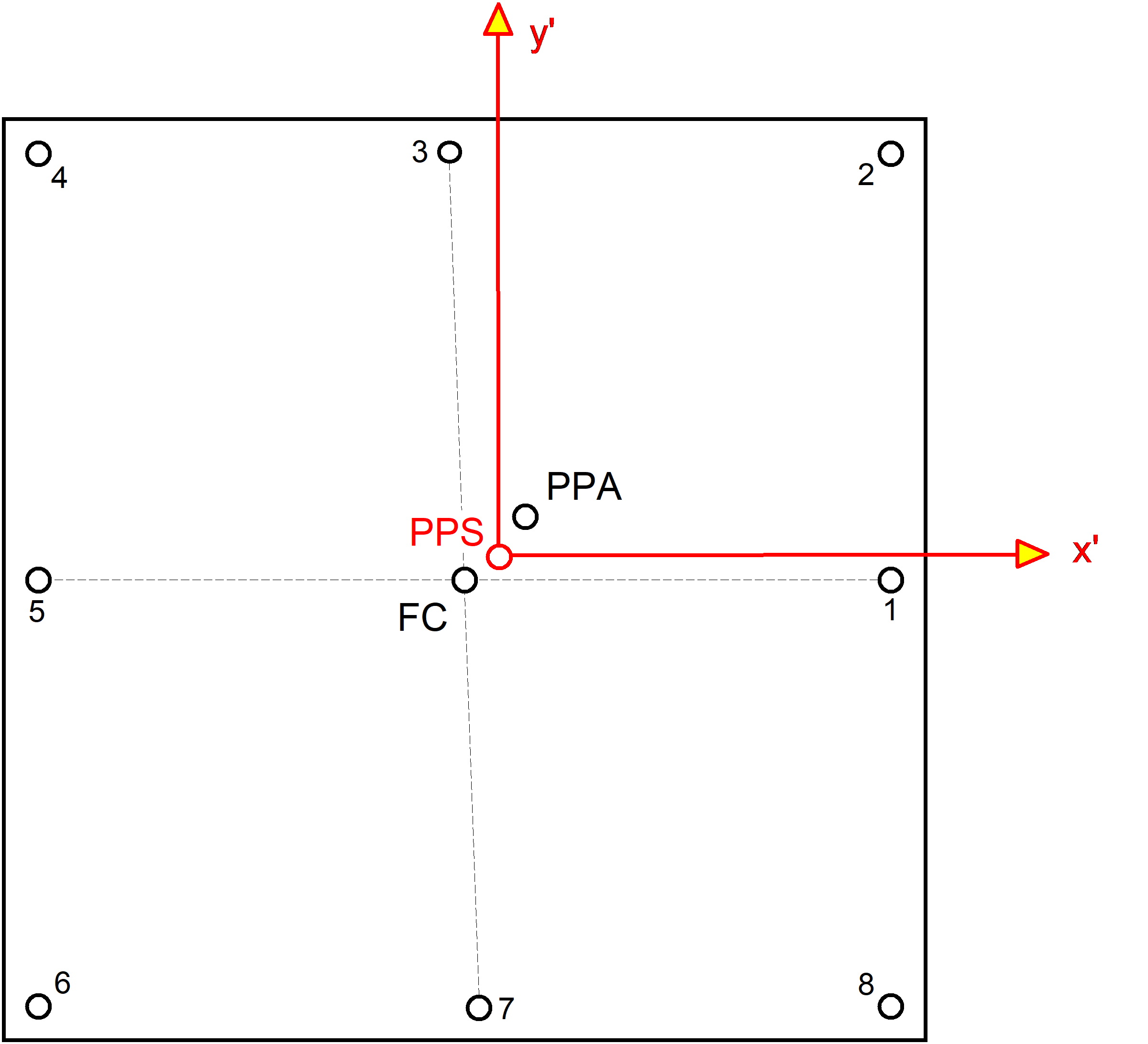
Fig. 4.1-1 Coordinate system of a photograph
In order to achieve correct results, a homogeneous reference system for the image measurements must be chosen. For analogue film cameras transformation of the image measurements to theoretical coordinates of fiducial marks or to theoretical coordinates of reseau points is recommended. The origin of this coordinate system should be the symmetry point PPS. If no theoretical coordinates are available, then it is recommended to create a homogeneous reference system. The fiducial marks of the first photo are reduced to the fiducial centre and rotated, until the points 1 and 5 lie on the x'-axis (see Fig. 4-1). The following photo then may be related to the fiducial marks of the first photo (program TRABI).
For digital cameras the reference of the photo coordinates should be the middle of the image.
If there is no homogeneous reference system for all image measurements, then no reasonable results can be achieved when applying additional parameters. Moreover, difficulties are to be expected for GPS/IMU applications, in orientation on image stations and for stereo metric camera conditions.
The greatest care has to be taken in the numbering and measurement of fiducial marks in the various photos, as errors can easily occur. These errors are sometimes difficult to find. Correct numbering may be checked (for example during image measurement) by the position of the exposed photo name.
Therefore it is recommended to define a (n+1), i.e. e.g. a ninth fiducial mark. The coordinate value indicates the position of the photo name appearing at the photo frame. In every case a position has to be chosen, which is asymmetric to all other fiducials. During the measurement of the inner orientation, this point will be pre-positioned automatically at the end of the measurements. If no photo name is found at this place, the whole inner orientation has to be repeated, as either the photo had been mounted wrongly or the assignment of the fiducials had been incorrect. If the photo name is found at this place, the picture is mounted correctly. The photo name can now be compared once more. The coordinate at this place will then not be measured but left out (skipped). Then the measurement of the tie points can be started. Such a procedure is a good insurance against errors.
All photos should also be positioned in the same way in the measuring instrument or photo scanner (for example: image names always in the same position), to avoid different influences from residual errors in the instrument.
Correction of the photo measurements:
Generally it is highly recommended to apply neither earth curvature correction and refraction correction nor lens distortion at the photo coordinates! These corrections are carried out in BINGO if necessary.
Position of the principal point:
For highest accuracy requirements differences between PPS and PPA have to be considered. The origin of the photo coordinate system is defined in BINGO as PPS. This way of definition gives a better clarity and facilitates the practical work. The following procedure is highly recommended:
- The fiducial reference coordinates of all cameras are to be transformed that PPS becomes the origin (0.0, 0.0). In the most cases for new calibration reports PPS is already selected as the origin of the coordinate system. (Except in case of calibration by the USGS.)
- The output of photo coordinates from measuring programs shall neither correct a lens distortion nor redefine the photo coordinates to PPA. (I.e. the fiducial reference coordinates will always be carried along as the reference values. After transformation they will still have these values - except some small random residuals.)
- PPA related to PPS will be introduced in BINGO in the CAPA statement as principal point. The lens distortion will be entered in the RADI statement. Compare Section 5.1.
If the adjustment of the principal point will be included in BINGO, the result of PPA is always related to PPS.
If additional parameters (ADPA statement) are applied simultaneously with a given lens distortion (RADI statement) BINGO lists behind the values of the estimated additional parameters
- the radial symmetric lens distortion effects from the used additional parameters and
- the summarised lens distortion curve from the RADI statement and the additional parameters.
The given step width from the RADI statement will be maintained.
Explanations
- Principal Point of Symmetry PPS:
This point will be selected during camera calibration in that way that the differences of lens distortion in all diagonal directions will be minimised. For this reason it is the origin of the lens distortion.
- Principal Point of Autokollimation PPA:
This is the origin of the central perspective. It represents the exposure direction in the image space and is always the reference point for the collinearity equation.
- Fiducial Centre FC:
This point was used to mount aerial photographs centred in analogue photogrammetric instruments. In the analytical photogrammetry it is still used for historical reasons; however it has no further meaning here anymore.
Important note:
In several cases the camera data is not related to PPS, or the photogrammetic system does not include indications whether the meaning of ″principal point″ is PPS or PPA. Thus it is very important to pay attention on the origin of the image coordinates which must be PPS, because – contrarily to PPA – PPS cannot be changed by the user.
PPA has been calibrated in the factory with a precision of about ± 20 µm. During the application of DGPS data, these ± 20 µm already lead to a change in position of 16°cm in the object space, using e.g. a photo scale of 1:8000. If using GPS data, PPA has to be calibrated simultaneously as GPS measurements are of higher precision.
When working on a big block, e.g. with 5000 photos in partial blocks of 1000 photos each, it is absolutely possible that the following situation arises: the first block has already been measured, the bundle adjustment will be effected by the self-calibration. PPA receives new coordinates. These coordinates are transferred into the photogrammetric system. If PPA was the reference, chaos is bound to follow. All subsequent measurements will then be processed with a new reference.